
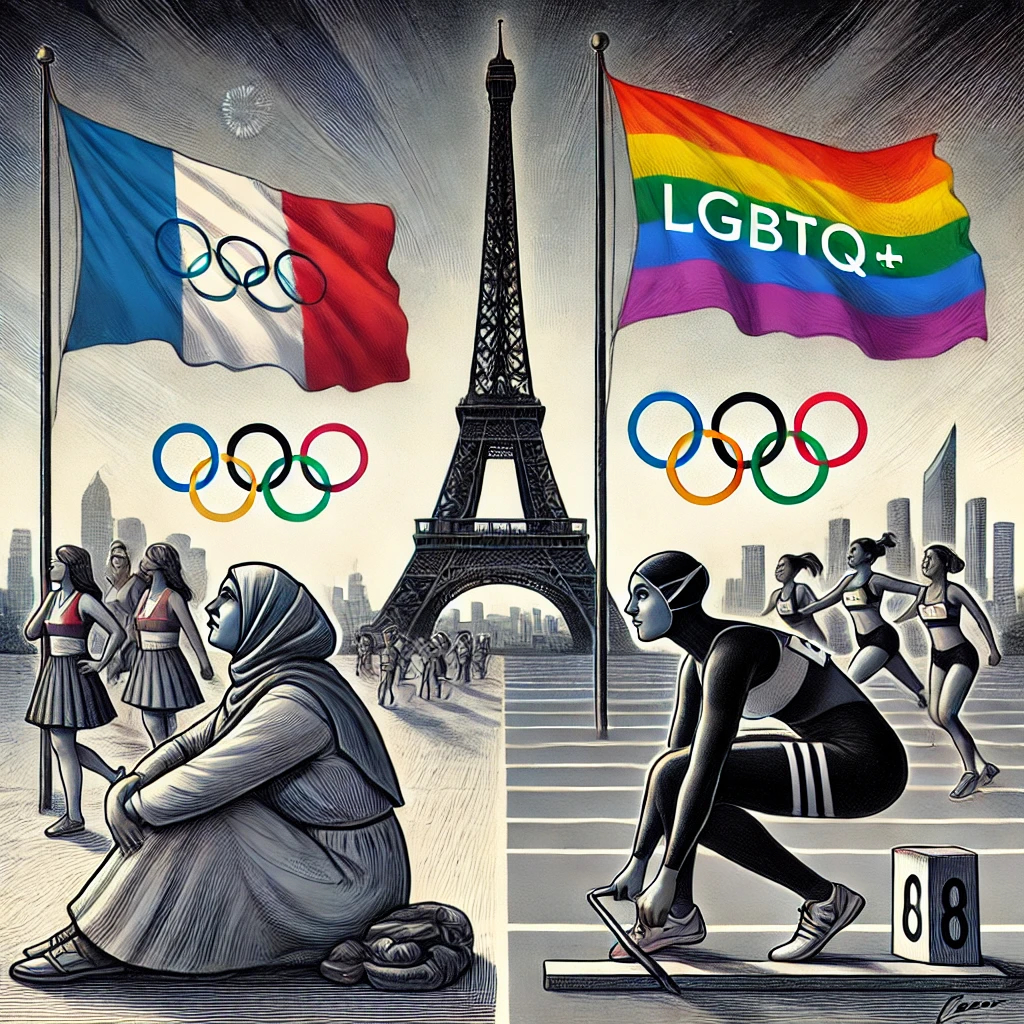
Before spicing things up, let’s recognize one thing: Paris nailed the Olympic opening ceremony. Not that I watched the whole thing or that I am an Olympic ceremony expert. But when Parisians – who dislike most things and French stand-up comedians – who made fun of the games for months, come together and celebrate the moment, you know something extraordinary happened.
Now, let’s address the more contentious aspects. Despite celebrating diversity during the ceremony, a few days after the opening, the presence of underlying contradictions is a stark reminder of the complexities and ongoing challenges in achieving true diversity, equity, and inclusion. I am torn as I write this piece. A part of me loves that a country like France made a bold move and stood for DE&I. It is a big statement, especially in the current context, where France’s far right is the most popular ever. Nevertheless, France had a Black Woman, Aya Nakamura, performing with the National Guard. When her name was first floated as an artist to perform during the opening, she received a wave of racist abuse. According to some surveys, 49% of French people thought it would be a bad idea for her to perform. Nicky Doll, the French Drag Race host, lipsyncing to Dalida.
Another part of me is saddened by how much France continues to hate Islam and clamp down on the hijab. How can all athletes, except the one from France, compete with the hijab?
Should I appreciate and celebrate France’s progress, or should I be appalled at the irony of the situation?
Let’s dig deeper and first better understand France’s position. Here is a statement from TIME:” The IOC said that while its own rules mean that women are free to observe the hijab, athletes competing for French national teams are considered to be civil servants who must act in accordance with national contexts”. In a nutshell, because they represent France, they are not allowed to wear the hijab. However, there are no rules set by the International Olympic Committee. Hence, athletes from other countries are permitted to wear the hijab.
Women already face many barriers in sports. Why is France the only country participating in the Olympics in the world that prohibits its female athletes from wearing hijabs? You read this right. Of all the countries participating, only France excludes women from wearing hijab.
Diversity conversations in France are insidious. People hide behind fancy terms such as “secularism,” “embody public service,” etc. They find ways to elevate their arguments as noble. You may hear, “I uphold the value of the republic,” which to me is the same thing as saying in the US, “I am a patriot.” Nothing good usually comes before someone says that. In both situations, it tends to be a reason to act like a bigot.
However, most of us know what is going on. Islamophobia is growing fast in France. I hear it more and more in my friends’ circles. Everyone knows at least 1 person who historically would not be an islamophobe, leaning more and more in that direction.
Coming back to my original question. Should I appreciate and celebrate France’s progress, or should I be appalled at the irony of the situation?
The answer is probably both. Let’s celebrate the progress and learn from it. By understanding the complexities and contradictions, we can better navigate the path towards true diversity and inclusion.
I love the concept of the Pride Houses at the Olympics. These are places where LGBTQ+ fans and Olympic athletes can eat, drink, and watch LGBTQ+ athletes compete in the Olympics. They also provide a safe space for athletes who may come from countries with anti-gay laws. Dean Nelson, who specializes in LGBTQ+ tourism, started the Pride Houses a decade ago in Vancouver. The Paris Pride Houses are the first ones to be officially backed by the IOC, marking a significant step towards LGBTQ+ inclusion in the Olympic Games.
While we celebrate the progress, it’s crucial that we remain critical and continue to push the boundaries. Let’s advocate for real, meaningful, and sustainable change. The kind of change that’s so deeply rooted that even when the trends of what diversity is acceptable change, the foundations are so strong that we can no longer move backwards. This is a call for critical thinking and active participation in shaping an ever more inclusive future. Your voice and your actions matter in this journey.

 The Black Negotiator