
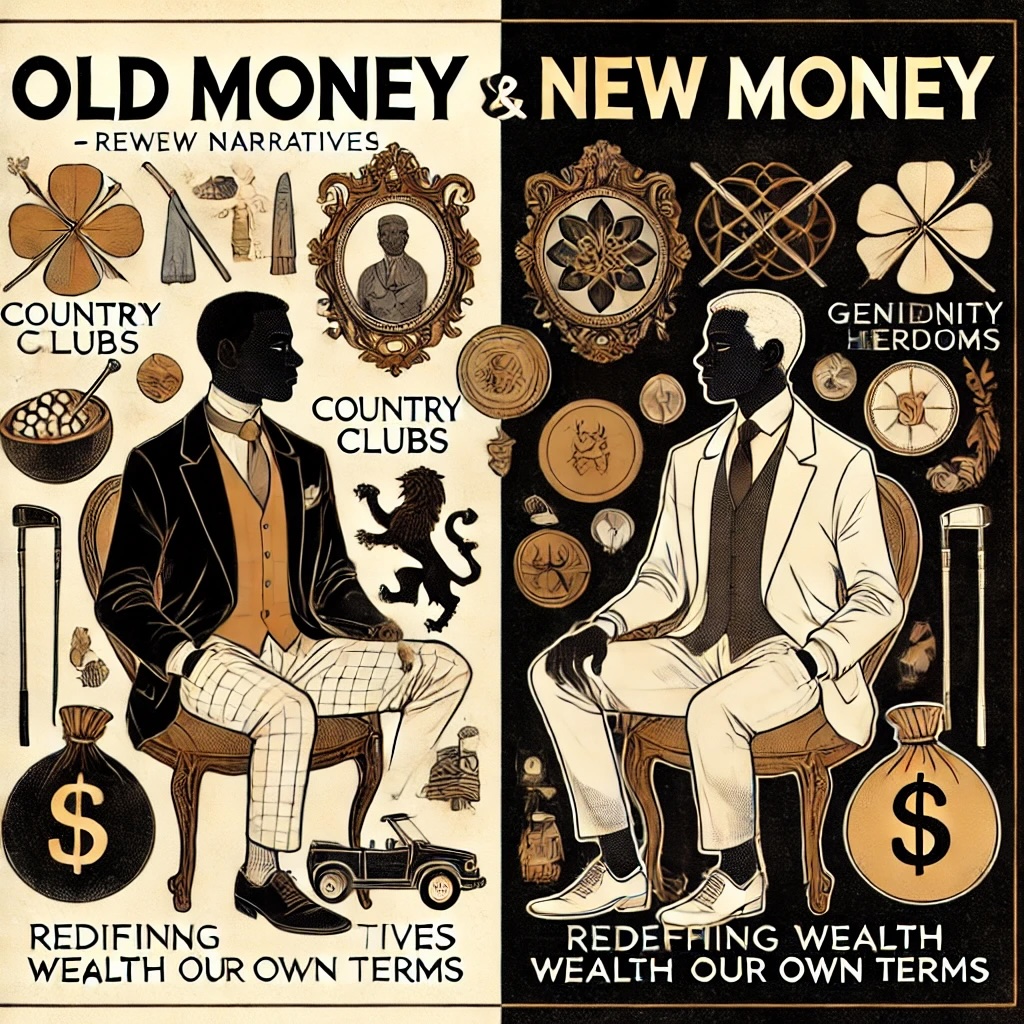
Have you ever noticed how society glorifies “old money” but sneers at “new money”? Old Money make you think of country clubs, inheritances, and trust funds; New Money makes you think of bling and boldness. Traditionally, “old money” meant wealthy families (usually white) who passed down riches through generations, often prideful of tradition and lineage. Their wealth was considered dignified – the kind that doesn’t need to show off. Meanwhile, “new money” gets portrayed as classless, as if those who earned wealth recently don’t know how to “behave rich.” But in reality, most “old money” got a centuries-long head start precisely because other communities were excluded from accumulating wealth. By putting old money on a pedestal, we’re often unknowingly celebrating a system that thrived on inequality.
On the flip side, the “new money” stereotype has been used to undermine self-made success. It casts strivers and first-generation millionaires as flashy, and lacking refinement. Think about that: someone works hard, breaks barriers, achieves what previous generations couldn’t – and then society tells them they’re tacky for enjoying the fruits of their labor. It’s a narrative that disproportionately falls on people of color, who, due to systemic barriers, are more often in that “new money” category . In other words, when a Black entrepreneur or artist rises up, their success is seen as nouveau riche flash, whereas the old guard’s wealth is seen as classy. Time to scrap that!
It’s time to flip this script. There’s nothing virtuous about money just because it’s old, and nothing inherently shameful about money that’s new. We define what our wealth means. What if “new money” for us meant new values and new intentions? Instead of chasing the validation of the old guard, we create a narrative where our money – whether it’s new or old – is defined by empowerment, generosity, and purpose. Our wealth can be quiet not because we’re ashamed or trying to fit in with someone else’s rules, but because we are confidently building something real. They say wealth whispers and poverty shouts; perhaps our version of “new money” speaks in a calm, self-assured tone – one that doesn’t need to yell to prove itself.
For Black individuals redefining what success looks like, this could be liberating. It means we don’t have to measure ourselves by antiquated standards of prestige. We can drive a humble car but own acres of impact. We can skip the monogrammed cufflinks and instead fund a scholarship or start a community initiative. And we can absolutely enjoy nice things – there’s no shame in luxury – but we do it on our terms, not to prove a point. New Money (the perfume and the philosophy) is about claiming that narrative. Its scent carries a quiet confidence, a refined strength. It’s not about smelling “rich” in the traditional sense; it’s about embodying a richness of spirit. When you wear it, you’re part of a new story. In this story, wealth isn’t judged by how long your family has had it, but by what you do with it today. And in our story, “new money” isn’t a put-down – it’s a badge of honor for a generation transforming wealth into something deeper and more meaningful.

 The Black Negotiator